
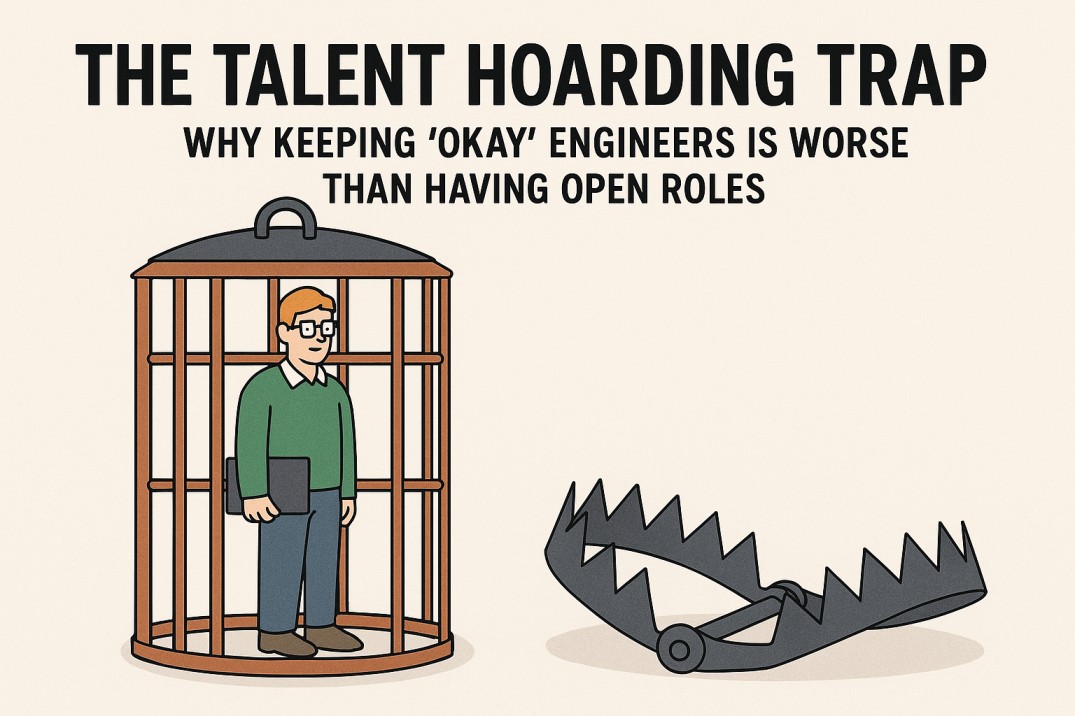
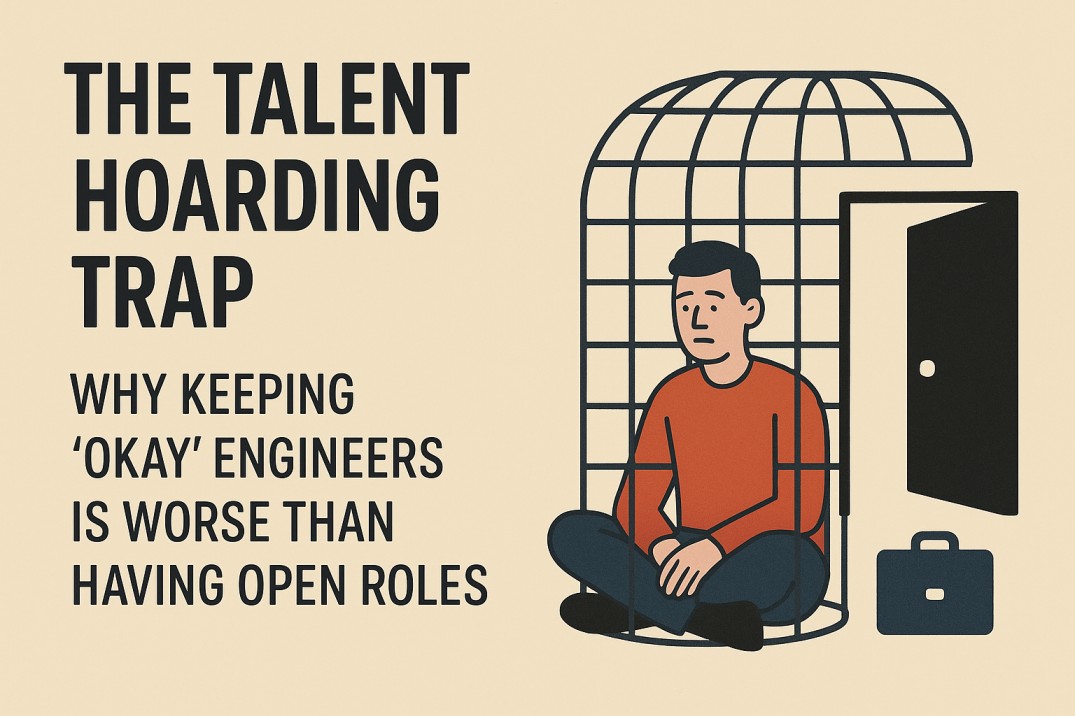
The Talent Hoarding Trap: Why Keeping "Okay" Engineers Is Worse Than Having Open Roles





Ad Spot Availabe




But they're also not moving the needle. Features take twice as long as they should. Code reviews are painful. Other engineers route around them instead of collaborating with them.
And yet, you keep them. Why? Because "we need the headcount" and "it's better than having an empty seat."
Wrong. Dead wrong.
Keeping mediocre engineers because you're afraid of having open roles is one of the most expensive mistakes in startup hiring. Let me show you why—and what to do instead.
(h2)The "Better Than Nothing" Fallacy(/h2)
Here's the logic founders use to justify keeping mediocre talent:
"Sure, they're not amazing, but:
They know the codebase
Hiring takes time
An empty seat means less output
They might improve eventually
Firing is uncomfortable."
Sounds reasonable, right?
Now let's look at the actual cost of keeping them:
Direct costs:
$100K+ in salary for below-average output
10-15 hours/week of senior engineer time reviewing their code
Features that take 3 weeks instead of 1 week
Bugs that other engineers have to fix
Technical debt from shortcuts they take
Indirect costs:
Your best engineers get frustrated and start looking elsewhere
New hires see the low bar and match it
Product velocity slows across the entire team
Customer experience suffers from poor-quality code
You can't hire better people because the role is "filled"
That last one is crucial: Mediocre engineers occupy seats that great engineers could fill.
Every day you keep them is a day you're not hiring someone who could actually move your company forward.
(h2)The Talent Hoarding Mindset(/h2)
Talent hoarding happens when founders treat headcount like a scarce resource that must be protected at all costs.
It shows up as:
"We can't fire anyone—we're already understaffed!"
"They're not great, but we need bodies on keyboards"
"Better to have them than to have nothing"
"We'll just hire more people to compensate."
This mindset comes from traditional corporate thinking, where headcount budgets are fixed and fighting for more heads is a political battle.
But startups aren't corporations. You don't have a fixed headcount budget approved by finance. You have runway, and every salary dollar should generate outsized returns.
Keeping a mediocre engineer "just in case" is like keeping a broken tool in your toolbox because "at least it's a tool." It's not helping—it's taking up space where a working tool could be.
(h2)What Mediocre Actually Costs You?(/h2)
Let's do the math on a single mediocre #remote developer earning $100K:
Scenario A: Keep the mediocre engineer
Salary: $100K
Output: 50% of what a good engineer produces
Team impact: Slows down 1 senior engineer by 15 hours/week (opportunity cost: $30K)
Code quality: Creates bugs that take 5 hours/month to fix across the team (opportunity cost: $10K)
Morale: Best engineers start interviewing (replacement cost: $50K+)
Total cost: $190K+ for 50% productivity
Scenario B: Fire them, hire better
4 weeks with empty role: $0 salary, slight velocity dip
New hire at $110K: Full productivity by week 2
Team impact: Senior engineers freed up to do senior work
Code quality: Clean code that doesn't need constant fixes
Morale: Team sees you care about quality
Total cost: $110K for 100% productivity + team morale boost
The math isn't close. Mediocre isn't "better than nothing." It's worse than nothing because it blocks you from getting something good.
(h2)How Mediocrity Spreads(/h2)
Here's the insidious part: mediocre engineers don't just underperform—they lower the bar for everyone.
New hires pattern-match to existing team members. If they see someone getting away with sloppy code, late deliveries, and minimal effort, they adjust their own standards accordingly.
A-players leave. Great engineers don't want to work with mediocre engineers. They leave for teams where everyone is strong.
Your hiring bar drops. When you're desperate to fill roles because mediocre engineers can't keep up, you start accepting more mediocre candidates.
Within 12-18 months, you go from "one okay engineer" to "a team of okay engineers" and wonder why your product isn't competitive anymore.
This is how startups die. Not dramatically, but gradually, as the talent level declines and nobody dares to fix it.
(h2)The False Comfort of "Knowing the Codebase"(/h2)
The most common justification for keeping mediocre engineers: "But they know our codebase!"
Let's examine this:
Mediocre engineer who knows the codebase:
Takes 3 weeks to implement a feature
Writes code that needs extensive review
Creates bugs that need fixing
Can't architect new systems
Blocks senior engineers from bigger problems
Strong #remote engineer who doesn't know the codebase:
Takes 1 week to learn relevant parts
Takes 2 weeks to implement the same feature (first time)
Writes clean, maintainable code
Catches architectural issues others miss
Frees up senior engineers to do senior work
By week 4, the new engineer is already ahead. By week 8, they're dramatically outperforming the mediocre one.
"Knowing the codebase" is worth about 2 weeks of ramp time. That's it. After that, raw competence matters infinitely more.
(h2)The Remote Difference(/h2)
#Remote work makes mediocre engineers more expensive because:
No hiding behind "looking busy." In an office, mediocre engineers can survive by appearing engaged. Remote work exposes actual output.
Async communication requires clarity. Mediocre engineers struggle to communicate technical concepts clearly in writing, slowing everything down.
Time zone differences amplify slowness. If a mediocre engineer in Europe takes 2 days to complete what should take 4 hours, the US-based team loses entire days waiting.
Code quality is more visible. PRs and documentation are the primary artifacts. Mediocre work is preserved in writing for everyone to see.
The best #remote teams maintain high bars because they have to. There's no office presence to compensate for low output.
(h2)When to Cut Them Loose(/h2)
Here's how to know if you're talent-hoarding:
Ask yourself:
If this person quit tomorrow, would I try to convince them to stay?
If this role were empty, would I hire this person again?
Am I keeping them out of fear rather than conviction?
Ask your team (anonymously):
Who on the team consistently delivers high-quality work?
Who would you want on your next project?
Who slows the team down?
If the same names appear in the "slows the team down" category repeatedly, you have your answer.
Look at the data:
How long do their tasks take vs. estimates?
How many rounds of code review do their PRs need?
How many bugs are traced back to their code?
How often do other engineers have to help them?
Data doesn't lie. If someone consistently underperforms on objective metrics, they're not suddenly going to become great.
(h2)The Right Way to Handle It(/h2)
If you've decided someone needs to go, here's the process:
1. Give Clear Feedback First
Don't ambush people. Have a direct conversation:
"Your output isn't meeting the bar we need. Specifically: [examples with data]. Here's what needs to change: [clear expectations]. Let's check in weekly and see if we're on track."
Give them 2-4 weeks to improve with clear metrics. Some people genuinely don't realize they're underperforming and will step up.
2. If Nothing Changes, Move Fast
After clear feedback and adequate time, if performance hasn't improved, let them go.
"We discussed performance expectations [date]. I haven't seen the improvement we need. Today will be your last day. We'll provide [severance details] and support the transition."
Be kind but firm. Don't drag it out.
3. Hire Better Immediately
Don't leave the role empty for months. Get on jobserver.ai and start sourcing pre-vetted #remote talent immediately.
The goal isn't to have an empty seat. It's to upgrade from mediocre to great as fast as possible.
What "Great" Actually Looks Like
Stop settling for "fine." Here's what great engineers do:
They ship features faster than estimates. Not because they cut corners, but because they're actually good.
Their code rarely needs revision. First PR is usually good enough to merge with minor tweaks.
They unblock themselves. They debug, research, and solve problems without constant hand-holding.
They improve the codebase. They leave things better than they found them.
They make others better. Code reviews are learning opportunities. Their documentation helps everyone.
They communicate clearly. Async updates are concise and complete. No constant back-and-forth for clarification.
This isn't unicorn territory. This is standard for actually good engineers. If your team doesn't have people like this, you're settling.
The #AI Hiring Angle
Right now, startups are desperate to hire #AI engineers. This desperation leads to:
Hiring anyone with "AI" on their resume
Keeping weak #AI engineers because "at least they know PyTorch"
Lowering the bar because "AI talent is scarce"
This is talent hoarding disguised as pragmatism.
The truth? Good #AI engineers exist in abundance in the global #remote market. You're just looking in the wrong places.
Platforms like jobserver.ai specialize in connecting startups with pre-vetted #remote #AI talent. Instead of keeping a mediocre ML engineer because you're afraid you can't find better, you could hire someone demonstrably better in 2-3 weeks.
The "AI talent is scarce" narrative is false. Local AI talent in SF and NYC is scarce. Global #remote AI talent is plentiful.
The Uncomfortable Truth
Keeping mediocre engineers isn't kindness. It's cowardice.
You're hurting:
Your company: Slow velocity, poor quality, wasted money
Your team: Frustration, lowered standards, burnout from carrying dead weight
The mediocre engineer: Keeping them in a role they're failing at instead of helping them find something they're good at
Better candidates: Blocking them from a role where they could thrive
The kind thing is to maintain high standards, give clear feedback, and move on quickly when someone isn't working out.
The cruel thing is keeping someone in a job they're barely adequate at for years, then firing them when the company is desperate.
(h2)The Bottom Line(/h2)
Empty seats are temporary. Mediocre engineers are permanent (until you fire them, which you'll eventually do anyway).
Stop hoarding talent. Stop keeping "okay" engineers because you're afraid of having open roles. Stop settling.
Your startup doesn't need more engineers. It needs better engineers.
Fire the mediocre ones. Use jobserver.ai to find pre-vetted #remote #AI talent who can actually deliver. Upgrade your team before your competitors do.
The startups winning right now don't have the biggest teams. They have the best teams. And they got there by refusing to settle for "fine."
You can have open roles, or you can have mediocre engineers. Both slow you down. But only one of them is fixable in 2-3 weeks.
Choose wisely.


Category:
Other
Region:
Australia
Author:
foradserver@gmail.com
Ad link: