
The 72-Hour Hiring Test: Why Fast Startups Win (And How to Hire Remote Talent in Days, Not Months)





Ad Spot Availabe




How? They made an offer in 72 hours while you were still scheduling "culture fit" round three.
Speed isn't just a nice-to-have in startup hiring—it's the difference between building your product and watching competitors build it first. Yet most founders treat hiring like a enterprise corporation, complete with 6-round interviews and committee decisions.
Here's why that's killing your startup, and how the fastest-moving companies are hiring #remote talent in days instead of months.
(hr)
(h2)The Speed Tax You're Paying(/h2)
Every day a critical role sits empty costs you more than salary. It costs:
Momentum. Features that should be shipping this month get pushed to next quarter. Your roadmap becomes a wishlist.
Morale. Your existing team is stretched thin, covering for the role you haven't filled. Burnout creeps in. Good people start looking elsewhere.
Market position. Your competitor with a full team ships faster, learns faster, and captures users while you're still hiring.
The best candidates. Top #remote developers get multiple offers. The ones you want most have the shortest shelf life. While you're deliberating, someone else is onboarding them.
A study of 2,000+ startup hires found that roles that took longer than 30 days to fill had 3x higher first-year turnover. Why? Because the best candidates accept quickly. If your process takes two months, you're not getting the best—you're getting whoever is still available.
(hrr)
(h2)Why Traditional Hiring Is Slow(/h2)
Most startup hiring processes are accidentally designed for slowness:
Step 1: Post on LinkedIn/Indeed (2-3 days to go live)
Step 2: Wait for applications (1-2 weeks)
Step 3: Screen 200+ unqualified resumes (1-2 weeks)
Step 4: Phone screens with maybes (1 week)
Step 5: Technical assessment (1 week)
Step 6: Team interviews (1-2 weeks of calendar Tetris)
Step 7: Founder interview (another week because calendars)
Step 8: Reference checks (3-5 days)
Step 9: Offer discussion and negotiation (3-7 days)
Total: 6-10 weeks minimum.
And that's if everything goes smoothly. One founder vacation, one candidate ghosting, one "let's do one more interview round" and you're at 12+ weeks.
Meanwhile, the engineer who could have solved your scaling problems just accepted an offer from a company that moved in 72 hours.
(hr)
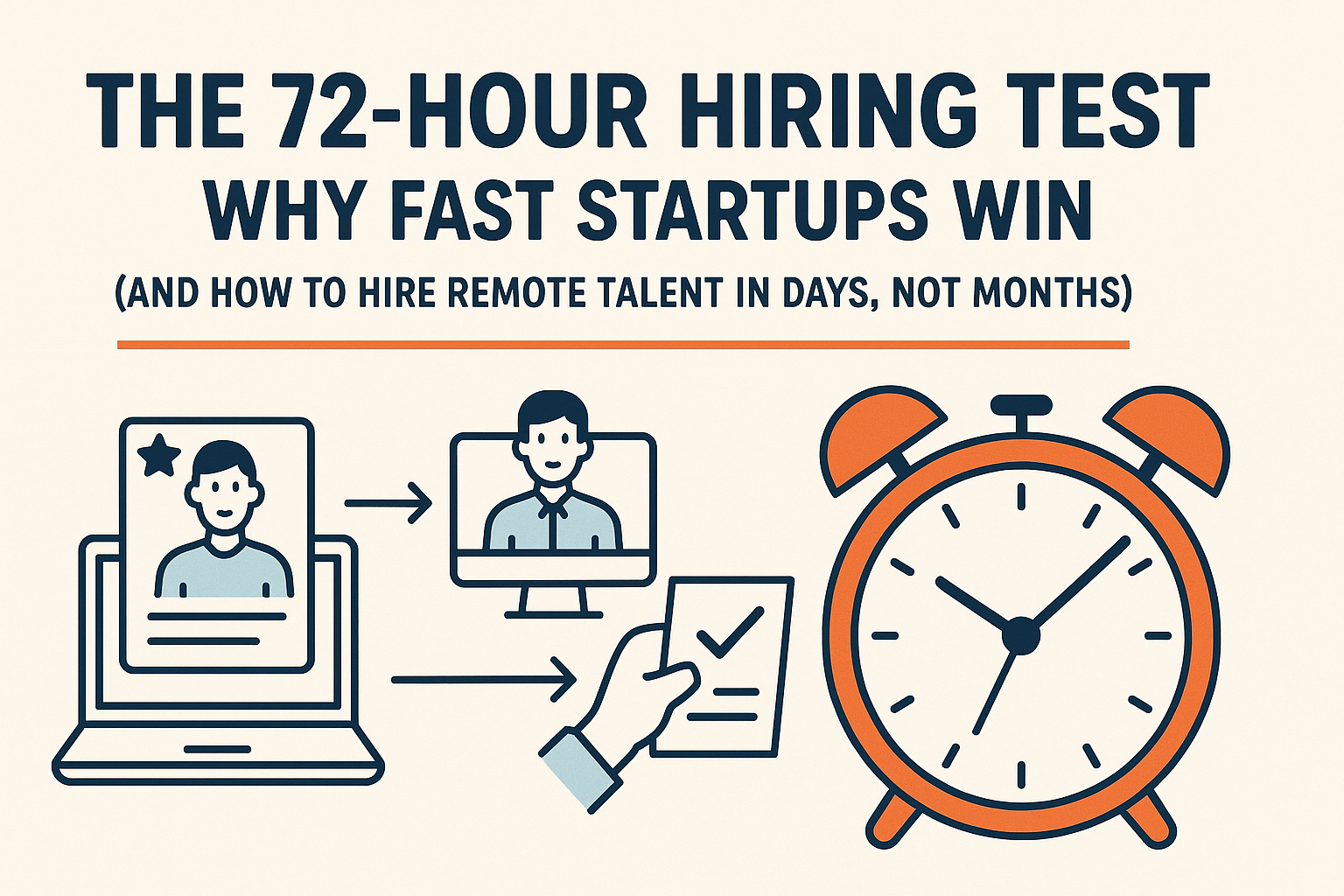
(h2)The 72-Hour Hiring Framework(/h2)
The fastest-moving startups don't skip steps—they compress and parallelize them. Here's how:
(hrr)
(h3)Day 1: Source and Screen (4 hours)(/h3)
Instead of posting and waiting, start with pre-qualified candidates. Platforms like jobserver.ai maintain pools of vetted #remote #AI talent who are actively looking, with verified skills and experience.
You're not screening 200 resumes. You're reviewing 5-10 candidates who already match your requirements.
Action: Review profiles, schedule calls for tomorrow with top 3 candidates.
(hr)
(h3)Day 2: Interview and Assess (6 hours)(/h3)
Combine your phone screen and technical interview into one 90-minute session:
First 30 minutes: Background, motivations, communication skills
Next 45 minutes: Technical discussion or live coding challenge
Final 15 minutes: Questions, culture alignment, logistics
Don't schedule these sequentially. Book all three candidates back-to-back and decide by end of day.
Action: Make your decision tonight. Pick your top candidate.
(hrr)
(h3)Day 3: Offer and Close (4 hours)(/h3)
Morning: Send the offer. Include:
Exact compensation breakdown
Equity details with clear explanation
Benefits summary
Start date options
24-48 hour decision window (not 2 weeks)
Afternoon: Get on a call to walk through the offer, answer questions, and address concerns in real-time.
Action: Close the candidate or move to your second choice immediately.
What Fast Hiring Actually Requires
This isn't about being reckless. It's about being prepared. Fast hiring works when you have:
(hr)
(h3)1. Clear role definition before you start(/h3)
You can't hire fast if you're figuring out what you need during interviews. Know exactly:
What problems this person will solve in month 1, 3, 6
Required vs. nice-to-have skills
Success metrics for the role
Compensation range you can offer
(hrr)
(h3)2. Streamlined decision-making(/h3)
Hiring by committee is hiring slowly. Designate one decision-maker (usually the founder or hiring manager) who can make the call without consensus-building meetings.
Get input from the team, but don't let perfect be the enemy of good. A solid hire today beats a perfect hire in two months (who probably doesn't exist anyway).
(hr)
(h3)3. Pre-vetted talent pools(/h3)
The 72-hour model only works if you're not starting from scratch. You need candidates who are:
Already screened for basic qualifications
Actively job-searching (not passive browsing)
Available to start soon
Verified for claimed skills and experience
This is exactly why smart founders use jobserver.ai—you're not building the pipeline from zero. You're selecting from candidates who are ready to move fast.
(hrr)
(h2)The Remote Advantage for Speed(/h2)
#Remote hiring is naturally faster than local hiring:
Larger talent pool = Higher chance of finding the right person immediately instead of waiting for them to appear in your city
No relocation logistics = Candidate can start next week, not next month after they move
Async-friendly process = No calendar Tetris across one office. Do interviews across time zones efficiently.
Global availability = Someone's always awake and working, which compresses feedback loops
The startups hiring #remote-first aren't just accessing better talent—they're hiring that talent 3x faster.
(hrr)
(h2)Common Objections (And Why They're Wrong)(/h2)
"But we need to be thorough!"
Thorough ≠ slow. You can be rigorous in 72 hours. What you're cutting is redundancy and bureaucracy, not quality.
"What if we hire the wrong person?"
You'll find out faster with a compressed process. Most bad hires reveal themselves in the first 30 days anyway. The cost of one wrong hire is less than the cost of leaving a role empty for three months.
"Top candidates won't make a decision that fast!"
Wrong. Top candidates make decisions fast because they have options. It's mediocre candidates who need weeks to decide because you're their only offer.
"Our team needs to meet them first!"
Build team input into Day 2. A 30-minute team conversation is enough to identify red flags. You're hiring a professional, not a roommate.
(hrr)
(h2)What This Looks Like In Practice(/h2)
Real example: A fintech startup needed a senior backend engineer to handle their scaling problems. Their infrastructure was buckling under growth.
(hr)
(h2)Traditional approach timeline:(/h2)
Post on LinkedIn: Week 1
Screen applications: Week 2-3
Technical interviews: Week 4-5
Team/founder interviews: Week 6-7
Offer negotiation: Week 8
Total: 2 months
By that point, they'd lost two major clients to performance issues.
(hr)
(h2)Fast approach timeline:(/h2)
Connected with pre-vetted candidates on jobserver.ai: Day 1 morning
Conducted 3 interviews with qualified #remote engineers: Day 1 afternoon + Day 2
Made offer to top choice: Day 2 evening
Candidate accepted: Day 3 morning
Total: 72 hours
Engineer started the following Monday. Scaling issues resolved within three weeks. Crisis averted.
The difference? The second company didn't waste time building the pipeline from scratch. They started with qualified candidates ready to move fast.
(hr)
(h2)The Competitive Advantage of Speed(/h2)
In 2025, hiring speed is a competitive moat. While your competitors are running 8-week hiring processes, you're:
Shipping features faster with full teams
Responding to market changes with adequate talent
Building momentum that attracts more talent
Capturing opportunities that require quick execution
The startups that master fast #remote hiring don't just fill roles—they compound their advantages. Every week they're fully staffed while competitors are understaffed is a week they pull further ahead.
(hrr)
(h2)The Bottom Line(/h2)
You can't move fast as a startup with slow hiring. Every open role is dead weight slowing you down.
The 72-hour hiring model isn't about desperation or lowering standards. It's about respecting that:
Time is your most valuable resource
Top talent moves fast
Your competitors are hiring the people you're interviewing
An empty seat costs more than any individual salary
Stop treating hiring like a risk to be minimized through endless rounds. Start treating it like the growth accelerator it should be.
The tools exist. The #remote talent exists. The only question is whether you'll move fast enough to hire them before someone else does.
Check out (link=https://jobserver.ai/)jobserver(/link) and see how fast you can actually hire when you're working with pre-vetted #remote #AI talent. 72 hours might sound aggressive. But once you do it, you'll wonder why you ever waited months.



Category:
Other
Region:
North America
Author:
foradserver@gmail.com
Ad link: