

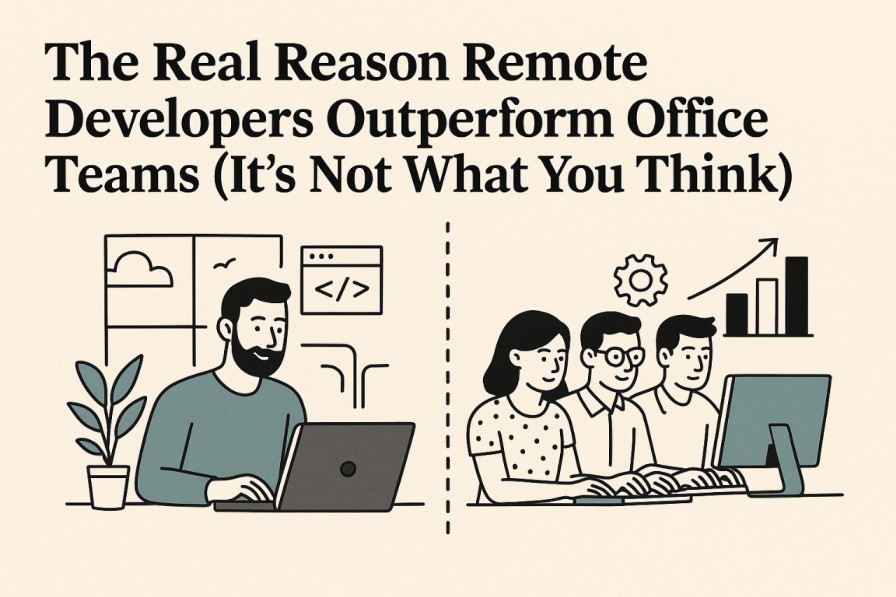
The Real Reason Remote Developers Outperform Office Teams (It's Not What You Think)





Ad Spot Availabe




Before you dismiss this as #remote work propaganda, let’s look at why this happens and what it means for startups trying to build high-performing engineering teams.
(h2)The Focus Advantage(/h2)
Here’s what most founders miss: coding isn’t a collaborative activity. It’s a deep-focus activity that requires uninterrupted concentration.
Office environments are focus killers. The average developer in an office gets interrupted every 11 minutes. Each interruption costs 23 minutes of recovery time to get back into deep work. Do the math—that’s barely any productive coding time in an 8-hour day.
#Remote developers control their environment. They can:
Block out focus time without someone tapping their shoulder.
Eliminate commute stress that drains mental energy.
Work during their peak productivity hours (which might not be 9-5)
Create a workspace optimized for concentration, not socialization
The result? More code shipped, fewer bugs, and better architecture decisions made during extended focus sessions.
(h2)The Meeting Tax(/h2)
Office culture defaults to meetings. Someone have a question? Schedule a meeting. Need alignment? Meeting. Status update? You guessed it—meeting.
#Remote teams are forced to be more intentional. When scheduling a meeting means coordinating across time zones, you suddenly realize most meetings could have been a Slack message or a Loom video.
The best remote engineering teams operate on a simple principle: async first, sync only when necessary. This means:
Documentation becomes the default (which helps everyone)
Decisions are made in writing (creating a searchable record)
People get answers when they need them, not when someone is available.
Engineers spend their time coding, not sitting in conference rooms
A study of 5,000+ engineering teams found that #remote developers spent 60% more time in their code editor compared to office-based developers. That’s the difference between shipping features and talking about shipping features.
(h2)The Talent Depth Problem(/h2)
When you hire only from your local area, you’re fishing in a small pond. That pond has been overfished by every other startup and tech company in your city.
The developers left in that pond either:
They aren’t very good (which is why they’re still available)
They are extremely expensive (because demand outstrips supply)
Are about to get poached by your competitor
#Remote hiring changes the game completely. Suddenly, you have access to:
Senior developers in Eastern Europe with 10+ years of experience
#AI specialists in Latin America who cost half what SF developers charge
Full-stack engineers in Southeast Asia who can run circles around your current team
Platforms like jobserver.ai solve this exact problem—connecting startups with pre-vetted #remote developers globally, so you’re not limited by geography when building your team.
(h2)The Motivation Factor(/h2)
Office developers often treat their job as... a job. Show up at 9, leave at 5, collect a paycheck.
#Remote developers who choose remote work (not those forced into it) tend to be different. They’re:
Self-motivated enough to manage their own time
Disciplined enough to deliver without supervision
Results-oriented rather than optics-focused
They’re not showing up to be seen. They’re showing up to ship.
There’s also a hidden factor: #remote developers often accept slightly lower salaries in exchange for location flexibility. But they make up for it in productivity because they’re not burned out from commuting, office politics, or forced socializing.
(h2)The Real Collaboration Challenge(/h2)
Let’s address the elephant in the room: what about collaboration?
Yes, brainstorming on a whiteboard can be valuable. Yes, pair programming is sometimes useful. Yes, building relationships matters.
But here’s what office advocates won’t tell you: most “collaboration” in offices is actually interruption disguised as teamwork.
Real collaboration happens when:
Code is reviewed thoughtfully in pull requests (remote teams excel at this)
Architecture decisions are documented and discussed asynchronously.
Team members can dive deep into a problem together during scheduled sessions.
Knowledge is shared through documentation, not hallway conversations that exclude anyone not present.
The best remote teams schedule intentional collaboration time—2-3 hours of overlap for standups, pair programming sessions, or architecture discussions. The rest of the time? Deep work.
(h2)How to Actually Build High-Performing Remote Dev Teams(/h2)
If you’re convinced but not sure where to start, here’s the playbook:
Hire for output, not hours. Judge developers by what they ship, not when they’re online. This mindset shift is crucial.
Invest in async communication. Use tools like Loom for video updates, Notion for documentation, and Linear for project tracking. Make written communication a core skill.
Create overlap windows. Ensure your team has 2-4 hours of shared working time across time zones for real-time collaboration when needed.
Document everything. If it’s not written down, it doesn’t exist. This protects against knowledge silos and makes onboarding seamless.
Trust your people. Micromanaging remote developers is a fast track to losing them. Hire adults and treat them like adults.
(h2)The Uncomfortable Truth for Founders(/h2)
If your #remote developers aren’t performing well, the problem isn’t remote work. It’s one of three things:
You hired the wrong people.
Your processes aren’t built for remote work.
You’re managing them like they’re in an office.
Office presence can mask poor performance. #Remote work exposes it. That’s not a bug—it’s a feature.
The startups winning right now aren’t debating remote vs. office. They’ve moved past that conversation entirely. They’re focused on building great products with great people, wherever those people happen to be.
Your next 10x developer isn’t going to walk into your office. They’re already working remotely for someone smarter than you—or they’re available on jobserver.ai waiting for a startup that actually gets it.
The question isn’t whether #remote developers can outperform office teams. The question is whether you’ll adapt before your competitors do.



Category:
Other
Region:
North America
Author:
foradserver@gmail.com
Ad link: