

The Next Frontier of the Internet: A Holographic Reality Beyond Screens and Glasses





Ad Spot Availabe




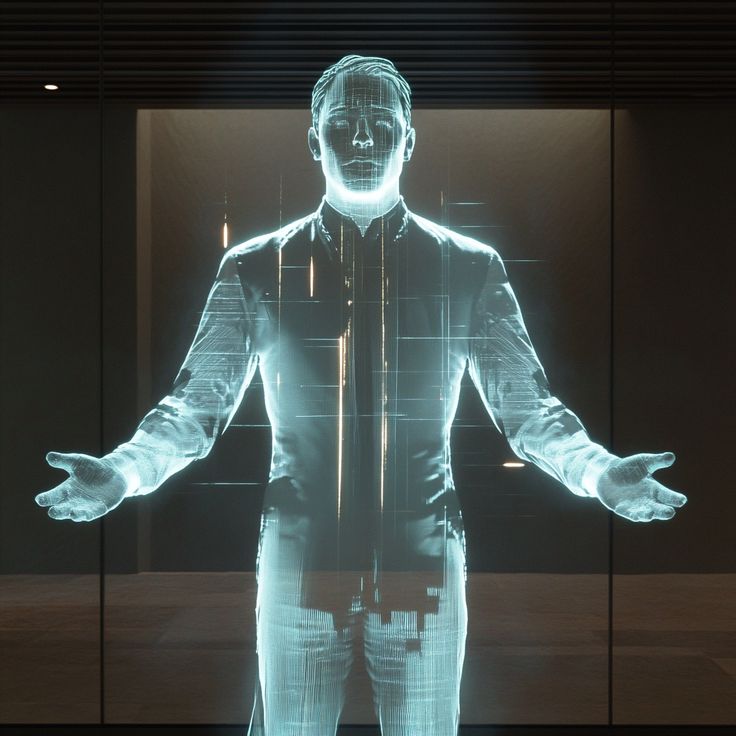
Augmented Reality (AR) glasses and headsets have attempted to bridge this gap, overlaying digital information onto our physical world. Yet, they still operate with a fundamental limitation: the digital and physical realms remain distinct. A new frontier of computing is now emerging, driven by a vision to turn reality itself into the ultimate platform. This is the concept of a "holographic internet," a world where digital information is not just overlaid but is seamlessly integrated into our physical environment. This would be an internet you can walk through, interact with, and even touch, with 3D holograms appearing in mid-air without the need for a screen or glasses. This ambitious endeavor is a high-stakes race between the world’s most powerful tech giants and a new wave of innovative startups, all vying to build the foundational architecture of the next generation of human-computer interaction.
(hr)
(h2)From Two Dimensions to Three(/h2)
The current internet, or Web 2.0, is built on a framework of hyperlinks and web pages, a structure designed for a flat screen. The next evolution, often referred to as the "Spatial Web," requires a completely new paradigm.
(h3)The Limitations of Current AR(/h3)
Current Augmented Reality is an impressive but imperfect solution. A user must wear a headset or use their phone to see digital content. The experience is personal and often limited to a single field of view. The next-generation internet aims to be a public, shared, and truly integrated experience. The goal is to create a reality where digital information is not a layer on top of the world but is part of the world itself. Imagine walking down a street and seeing a three-dimensional hologram of a friend, or seeing a holographic menu floating in a restaurant window without the need for a device.
(hr)
(vimeo=https://vimeo.com/1118761238)(/vimeo)
(h2)The Technologies Building a New Reality(/h2)
The shift to a holographic internet is not a single invention but a convergence of cutting-edge technologies that work together to create a new reality. The most crucial components are volumetric displays and haptic feedback.
(h3)Volumetric Displays and Light Fields(/h3)
Unlike traditional screens that project a 2D image, (b)volumetric displays(/b) project a true 3D image into a physical space. These displays are not creating a trick of the eye but are using a variety of techniques to project light into three dimensions. Some use rapidly moving surfaces, while others use lasers to create points of light in mid-air. The result is a floating, three-dimensional hologram that can be viewed from any angle. Companies are also developing "light field" technology, which captures and projects light information from every angle, creating a perfect holographic representation that can be seen without glasses or headsets. These technologies are the foundation of a shared, public holographic reality.
(h3)Haptics and Spatial Computing(/h3)
A truly integrated holographic world requires more than just visuals; it needs to be interactive. (b)Haptic feedback(/b) technology is being developed to allow a user to "touch" and "feel" a hologram. Using focused ultrasound, these devices can create physical sensations in mid-air, allowing a person to feel the texture of a virtual object or the impact of a holographic button. This adds a crucial layer of immersion and interaction, making the holographic world not just something to be seen, but to be felt. This entire ecosystem is being built on the principles of (b)spatial computing(/b), where machines understand and can interact with the physical world around them. This requires advanced computer vision, sensor fusion, and AI to create a seamless blend of digital and physical.
(hr)
(vimeo=https://vimeo.com/1121593727)(/vimeo)
(h2)The Real-World Applications(/h2)
The applications of a holographic internet are vast and extend far beyond entertainment and gaming. They have the potential to revolutionize a number of industries.
(h3)Education and Training(/h3)
In education, a holographic internet could transform the learning experience. A medical student could study a three-dimensional, anatomically perfect hologram of the human heart that they can walk around and interact with. A history class could view a holographic reconstruction of an ancient city, allowing students to explore it from every angle. This kind of experiential learning would be a monumental leap forward from textbooks and flat screens. In corporate training, complex machinery could be projected as a hologram, allowing engineers to train on new equipment without ever needing to touch the real thing.
(h3)Retail and Urban Planning(/h3)
In retail, a holographic internet could create new opportunities for advertising and commerce. A storefront could have a three-dimensional product display that appears in mid-air. In urban planning, architects could create holographic city models that can be explored by city planners and the public, allowing them to visualize new construction projects or infrastructure changes in a more intuitive and collaborative way.
(hr)
(h2)The Hurdles and the New Frontier(/h2)
While the vision of a holographic internet is compelling, (link=https://jobserver.ai/adserved?id=158&Ranking+the+Top+10+Google+Innovations+in+AI+and+Technology)the technology is still in its nascent stages and faces significant challenges.(/link) The hardware is incredibly expensive and power-hungry, and the software to create and manage a holographic world is still being developed. The biggest challenge, however, may be the ethical and privacy implications. A world where digital information is seamlessly integrated into our reality raises questions about constant surveillance, data ownership, and what it means to be a private individual in a public, holographic space. The choices we make now will determine whether this new frontier of the internet becomes a tool for human empowerment or a new landscape for exploitation. This is a critical #futureofinternet challenge.



Category:
Other
Region:
North America
Author:
blog@Jobserver.ai
Ad link: