

The Great Warehouse Automation Boom Powered by Robotics and AI





Ad Spot Availabe




It was a model of logistics that, while functional, was slow, prone to error, and struggled to keep pace with the demands of modern e-commerce. Today, this traditional world is being completely reinvented. (link=https://jobserver.ai/adserved?id=408&The+Port+of+the+Future%3A+An+Era+of+Automated+Shipping+Hubs)A new wave of robotics and artificial intelligence is not just assisting human workers, but is turning entire storage and distribution centers into sophisticated, autonomous ecosystems.(/link) This great automation boom promises to solve the core challenges of modern logistics, from the need for next-day delivery to the pressure to reduce costs, while fundamentally changing the very nature of work within these massive facilities.
(hr)
(h2)The Traditional Warehouse and Its Limitations(/h2)
The limitations of a traditional, human-powered warehouse are a direct result of the reliance on manual labor for repetitive, physically demanding tasks. The "person-to-goods" model, where a human worker must walk to a product’s location to retrieve it, is inherently inefficient.
(h3)A World of Inefficiency and Error(/h3)
In a conventional warehouse, a single order can require a worker to traverse long distances, find the correct item on a shelf, and then transport it to a packing station. This process is time-consuming, physically taxing, and, most importantly, prone to human error. A misplaced item, an incorrect pick, or a miscount can lead to costly returns and a decrease in customer satisfaction. During peak seasons, like holidays, the inefficiency of this model becomes even more pronounced, leading to bottlenecks and significant delays in order fulfillment. The manual handling of heavy or delicate items also introduces safety risks for employees. The antiquated nature of this system made it clear that a new solution was required to meet the demands of a fast-paced retail environment.
(hr)
(vimeo=https://vimeo.com/1121393028)(/vimeo)
(h2)The Rise of the Autonomous Ecosystem(/h2)
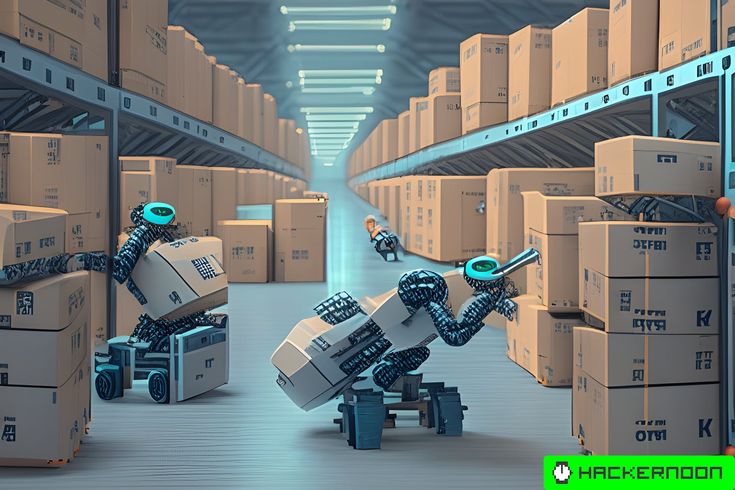
The automated warehouse operates on a completely different principle: a "goods-to-person" model, where the products are brought directly to the human workers, or in some cases, the entire process is handled autonomously. This transformation is powered by a combination of intelligent hardware and software.
(h3)The Robots at Work(/h3)
At the forefront of this revolution are a variety of robots designed for specific tasks. (b)Autonomous Mobile Robots (AMRs)(/b) are a common sight, navigating the warehouse floor using a combination of cameras, LiDAR, and sensors. Unlike their predecessors, (link=https://jobserver.ai/adserved?id=411&How+Self-Driving+Trucks+Are+Reinventing+Long-Haul+Freight+and+Logistics)Automated Guided Vehicles (AGVs) which followed predefined tracks, AMRs are intelligent and can independently plan the most efficient routes, avoiding obstacles and other robots.(/link) They are used to move shelves of products to picking stations, where either a human or a robotic arm can select the item. (b)Robotic picking arms(/b) are also becoming increasingly sophisticated, using advanced vision systems and AI to identify and pick a wide variety of products with speed and precision. These robots can work 24/7 without fatigue, a key advantage in meeting the high-volume demands of modern e-commerce.
(vimeo=https://vimeo.com/1121388771)(/vimeo)
(h3)The AI at the Center(/h3)
The brain of the automated warehouse is a sophisticated AI-powered warehouse management system. This software is responsible for orchestrating the entire autonomous ecosystem. It uses machine learning algorithms to analyze vast amounts of data in real-time, from incoming orders to inventory levels, to optimize every step of the process. The AI can predict future demand, dynamically assign tasks to robots, and even optimize the placement of products on shelves to reduce retrieval time. By continuously learning from its own data, the system becomes smarter and more efficient over time. This level of intelligent coordination allows for a seamless and highly responsive operation, fundamentally redefining the capabilities of a distribution center.
(hr)
(h2)The Benefits of Speed and Accuracy(/h2)
The integration of robotics and AI provides a number of clear and measurable benefits that have a direct impact on the bottom line and customer satisfaction.
(h3)Drastically Improved Efficiency(/h3)
One of the most immediate benefits of warehouse automation is the increase in speed and throughput. With robots working around the clock and AI optimizing every route and task, warehouses can process thousands of orders per hour with minimal human intervention. Companies that have integrated these systems report significant reductions in order fulfillment times, allowing them to meet and even exceed customer expectations for fast shipping. The automated systems are also incredibly accurate, with AI-powered quality checks ensuring that the correct products are picked and packed every time. This drastic reduction in errors leads to fewer returns, lower costs, and a more positive customer experience.
(hr)
(h2)Challenges and The Future of Work(/h2)
While the benefits of automation are clear, the transition to a fully automated warehouse is not without its challenges. The initial cost of implementing a robotic system is substantial, often requiring a major capital investment that may be prohibitive for smaller companies. The process of transitioning from a manual to an automated system can also be disruptive and complex.
(h3)A New Role for Human Labor(/h3)
The most significant and debated challenge is the impact on the workforce. As robots take over repetitive and physically demanding tasks, many traditional jobs are at risk of being automated away. However, the conversation is shifting from one of replacement to one of re-skilling. In the automated warehouse, human workers will be needed for higher-level tasks, such as managing the robotic fleet, performing maintenance, and overseeing the complex software systems. This transition requires companies to invest in training their existing workforce and hiring for new, more technical roles. The goal is to move human labor from the back-breaking work of picking and packing to more cognitive and supervisory roles, creating a safer and more stimulating work environment.
The warehouse of the future is an automated ecosystem powered by the collaborative intelligence of robots and AI. While the image of a traditional worker walking endless aisles may soon become a thing of the past, the core goal of logistics remains the same: to get the right product to the right customer at the right time. Automation is not changing the goal, but rather providing a powerful new set of tools to achieve it with an unprecedented level of speed, accuracy, and efficiency. The #warehouseautomation revolution is here, and it’s completely reshaping the world of retail and logistics.



Category:
Other
Region:
South America
Author:
blog@Jobserver.ai
Ad link: